
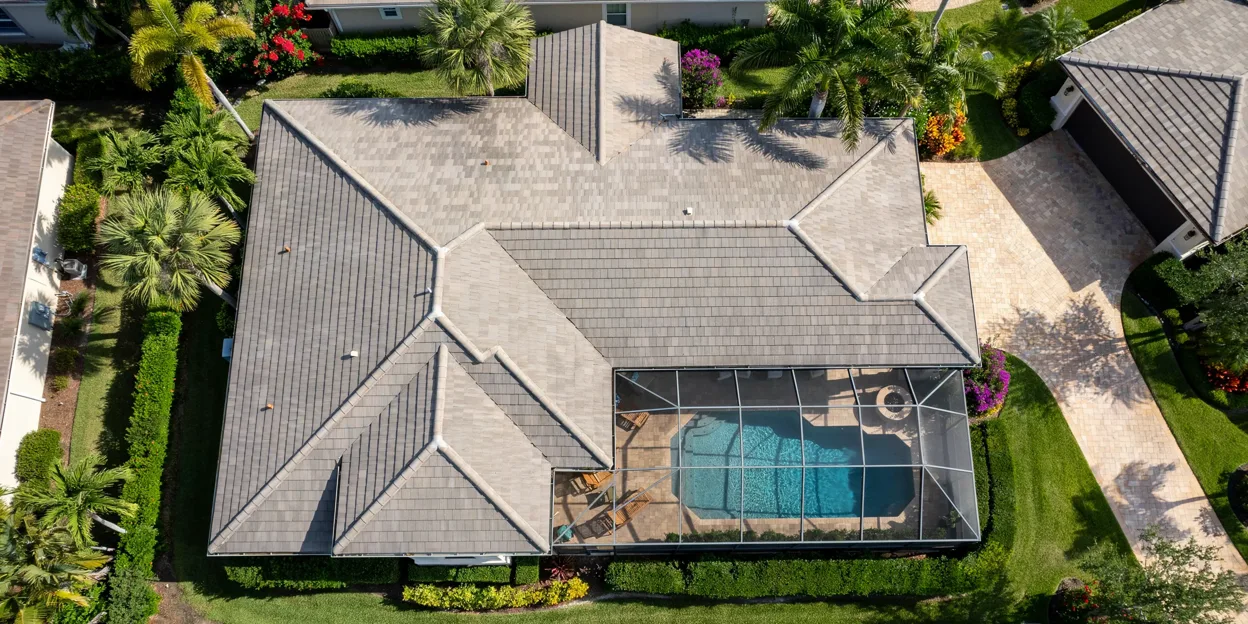
The house in Viera was built in 2005 to a code that already required clips on every truss and a nailed-down deck, and the premium has never reflected any of it because nobody ever filled out the form. This site connects you by phone with an independent local roofing contractor who handles wind-mitigation work in south Brevard County.
Florida requires every property insurer to accept one form, the Office of Insurance Regulation's OIR-B1-1802, filled out by a licensed inspector or contractor after a visit to the house. It records seven things: the code the roof was permitted under, the roof covering and its approval, how the deck is nailed, how the roof is tied to the walls (toe-nails, clips, single wraps, or double wraps), the roof shape (hip roofs score better than gable), whether there is a secondary water barrier under the covering, and whether the openings are protected. Each documented feature can move the wind portion of the premium.
The insurer credits the documentation, not the construction. A roof that qualifies on every line and has no form on file earns nothing.
The contractor goes into the attic with a camera. They photograph the nail pattern through the deck, the connectors at the truss-to-wall joint, and the underside of the covering. On the roof they identify the covering and check the permit date. Then the form is filled out with a photo for each rated feature, which the current version of the form requires.
If the house is mid-replacement, the same photos are taken while the deck is open, which is the only time some of them are easy to get.
Find the roof's permit year and the year the house was built. Both are on the permit record. Find the last wind-mitigation form if one exists; it is often in the closing documents or an old insurance file. Read your declarations page to see whether any mitigation credits are already applied. Then decide whether you are asking for a form on the roof you have or planning a roof replacement and want the credits built in.
Homes built or re-roofed since 2002 in Viera, West Melbourne, Bayside Lakes, and the newer sections of Palm Bay usually already have clips or straps, a nailed deck, and an approved covering. They often earn credit with no work at all beyond the inspection.
Older homes in Eau Gallie, Melbourne proper, and the 1980s sections of Palm Bay and Suntree are handled differently. Toe-nailed trusses can sometimes be retrofitted with clips from the attic side. A secondary water barrier and ring-shank re-nailing can only be added when the roof is off, which is why the roof replacement page treats the two jobs as one. A roof inspection tells you which lines the house can earn before you spend on either.
Opening protection is a separate line and a separate trade: shutters or impact windows on every opening. The roofing contractor notes what is there.
Brevard runs more than 70 miles along the Atlantic, and its barrier island is inside the wind-borne debris region, so carriers price wind first. The county publishes its own building code wind speed maps by address and risk category, and a beachside home sits at a higher design speed than an inland one on the same map. A new roof documented on the form is often the single thing that changes a renewal quote in this county.
What mitigation is not: a promise the roof will hold in every storm. It is better odds, a roof built the way the code now requires, and a form that makes the insurer price the house it actually has.
Have the address, the year the house was built, the roof's permit year if known, and the last form if one exists. Say whether you are planning a re-roof or want the form on the current roof. Call (321) 490-1097.
 Standing by
Describe the roof in plain words. The call is routed to an independent local roofing contractor who works shingle, metal, and tile roofs in your part of south Brevard County.
What to photograph, what a written roofing scope gives your adjuster, and how Florida's claim deadlines and roof-age rules work.
A lifted shingle, a rusted pipe boot, a valley that drips in every afternoon storm, or salt-eaten flashing on a beachside roof, found and fixed.
Tear-off to the deck, re-nailing, sealed underlayment, and a new shingle or metal roof permitted through the right city or county desk.